

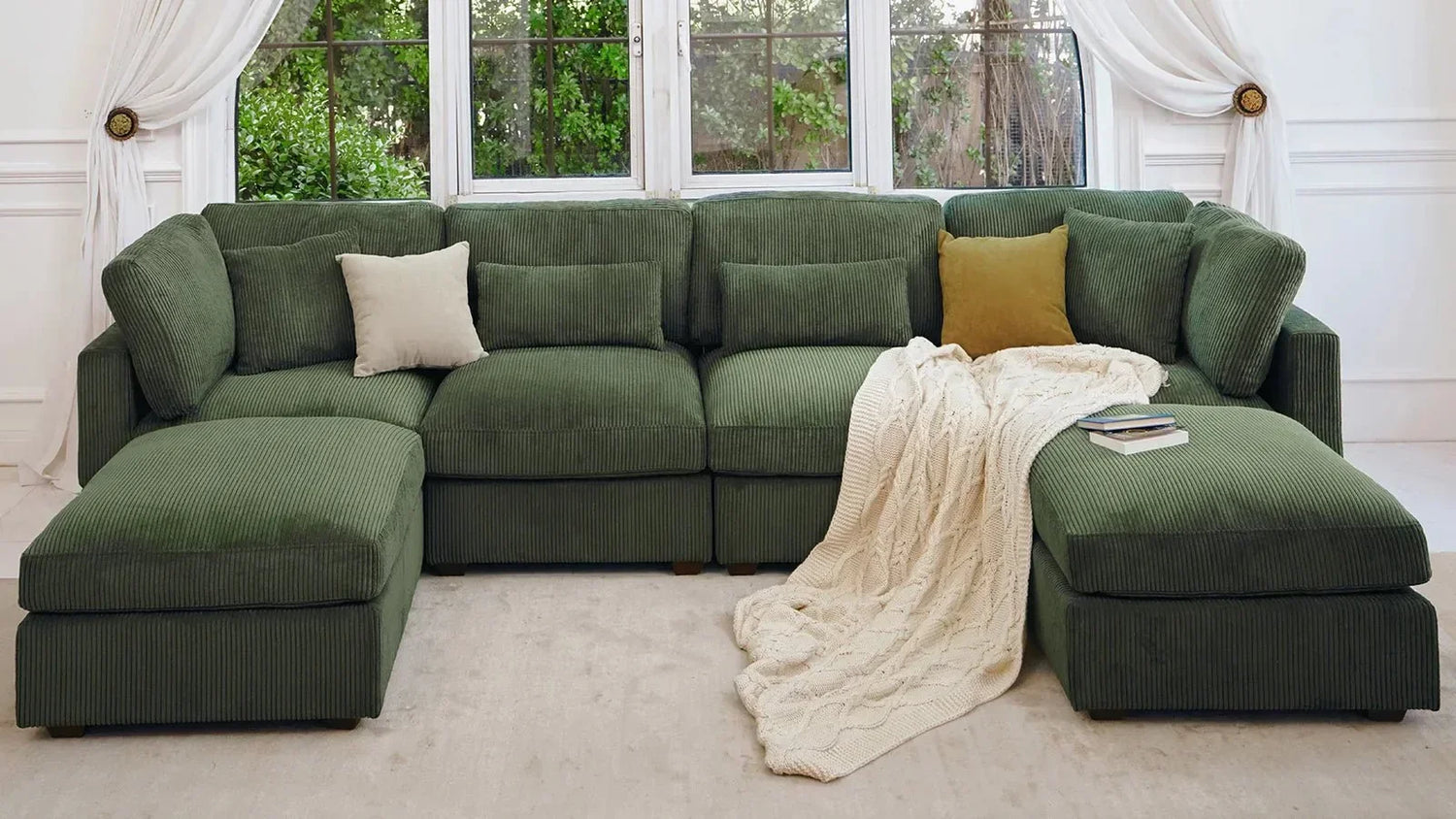
Modular sleeper sectionals all promise the same three things: seating, sleeping, and storage in one piece of furniture. How each configuration actually delivers on that promise varies more than most buyers expect. Arm width, storage placement, seat depth, and how many modules you're locked into (or free to rearrange) all change how well the sofa fits your room and how it holds up to your household. This guide breaks down the decisions that actually matter before you compare specific configurations side by side.
Room Size and Sleep Function Set the Starting Point
Before comparing features, two questions narrow the field faster than anything else:
- How much floor space do you actually have, not just for the sofa closed, but for the sofa with the bed pulled out and someone walking around it?
- How often will the sleeper function actually get used: a few nights a year for visiting family, or something closer to a regular guest bed?
A smaller household with occasional guests and a modest living room usually does better with a compact, 5-piece configuration that's easy to fit and easy to reconfigure. A household that hosts often, has more square footage to work with, or wants maximum lounging space day-to-day will get more out of a larger 7-piece, oversized layout, as long as the room can actually absorb the footprint, both closed and with the bed open.

Standard and Oversized Footprints
"Oversized" isn't just a marketing word. On paper, it shows up as extra inches in seat depth, module width, or overall footprint that a standard‑size sectional doesn't have. Here's what that actually looks like across three real configurations:
| Compact 5‑piece | Oversized block‑arm, 7‑piece | U‑shaped chaise, 7‑piece | |
|---|---|---|---|
| Overall footprint | 83.4"D × 83.4"W × 35"H | 113.4"L × 89.0"W × 35"H | 111.4"L × 111.4"W × 35"H |
| Seat depth | 20.5" | 23.2" | Deep combined chaise/ottoman zone |
| Ottoman | 22.8" × 22.8" × 18.1"H | 25.6" × 25.6" × 17.3"H | 31.5" × 28.3" × 18.3"H |
| Storage compartment | 20.1" × 20.1" × 8.1"H | 21.3" × 21.3" × 6.7"H | 52.8" × 22.4" × 7.9"H |
| Leg height | 2.4" | 2.4" | 2.3" |
The compact configuration is the easiest of the three to fit into an average living room. The other two both step up in overall footprint, but in different directions. The oversized block-arm layout stretches out along one axis, while the U-shaped chaise layout fills a fully symmetrical U, which needs more open floor space on two sides of the room rather than just one.

Movable Ottoman or Integrated Storage Chaise
Storage location changes how you actually use it day to day, not just how much it holds:
- The compact configuration keeps storage in the single seat and the ottoman, a smaller, movable footprint that's easy to reposition as a coffee table stand-in or pull closer to a specific seat.
- The oversized block-arm configuration spreads storage across an add-on ottoman, loveseat, and single seat, each sold and configured separately, so the household can decide exactly where storage volume goes.
- The U-shaped chaise configuration builds storage into a fixed chaise section with the largest compartment of the three (52.8" × 22.4" × 7.9"), which trades flexibility for the most storage volume in one place. That's useful for bulkier items like guest bedding, at the cost of not being able to move that storage elsewhere later.

Arm Width vs. Usable Seating
Arm design is one of the more visible differences between these three, and it directly trades off against seating space:
- The compact configuration uses a slimmer, standard arm profile (armrest depth around 31.9"), which keeps more of the overall footprint dedicated to actual seat cushion.
- The oversized block-arm configuration uses a wide, block-pattern arm (24.6" long, 7.1" wide) as a design feature. It reads as more substantial and contemporary, but that width is space the seating doesn't get.
- The U-shaped chaise configuration uses a tufted arm design (31.5" long, 6.7" wide) that sits between the two stylistically, pairing a more traditional detail with the U-shaped layout.
If maximizing seat count in a given footprint is the priority, a slimmer arm profile makes better use of the space. If the arm itself is meant to be a visual anchor in the room, a wider block-arm detail does more of that work.

The Number of Modules the Household Really Needs
More modules generally means more flexibility to rearrange, but it also means a bigger footprint and a higher starting price. A 5-piece configuration covers the core functions (seating, sleeper, and storage) in the smallest package. Stepping up to a 7-piece configuration adds a fuller U-shape or additional lounging modules, and in some cases, the option to buy further add-on pieces individually (extra armrests, an oversized corner seat, an additional pull-out bed, a storage loveseat, or extra storage modules).
A smaller household that just needs a comfortable sleeper and some storage rarely needs to start beyond a 5-piece layout. A household planning to host multiple guests, wanting a full U-shape for a larger family room, or expecting to expand the sofa over time will get more long-term value starting from a 7-piece base.
Where the Three Configurations Differ
Putting the comparison together:
- The compact 5-piece configuration is the most space-efficient and the lowest starting cost of the three, built in wide-wale corduroy with hidden storage in the single seat and ottoman. It suits smaller rooms, first-time sleeper-sectional buyers, and anyone prioritizing an efficient footprint alongside the pull-out and storage functions.
- The oversized block-arm, 7-piece configuration is the larger option, built for deep, plush seating with a modular add-on system that lets the household expand storage, seating, or the pull-out bed itself over time. It suits larger rooms and households that want to grow the configuration later.
- The U-shaped chaise, 7-piece configuration is the fully symmetrical option with the largest single storage compartment and a tufted arm detail. It suits households that specifically want a chaise-based U-shape, need the most storage volume in one place, and have the floor space on two sides of the room to support it.
All three include corduroy upholstery, a pull-out sleeper bed, and hidden storage as standard, though specific fabric and color choices differ by configuration. Listed prices change with active promotions, so treat any price you see as a snapshot rather than a fixed number. Check the current listing for the configuration you're considering before deciding based on price alone.
FAQs about Modular Sleeper Sectional Configurations
Q1: How do you decide between a 5-piece and a 7-piece sectional configuration?
Start with your room's actual floor space, both closed and with the sleeper bed open, and how often the sleeper function will get used. From there, compare footprint, storage placement, and arm width across the specific configurations you're considering, rather than choosing based on piece count or price alone.
Q2: How many sectional pieces does a typical household actually need?
It depends on the space and how you plan to use it. A 5-piece configuration covers seating, sleeping, and storage in a compact footprint that suits smaller rooms and occasional guests. A 7-piece configuration makes sense for larger rooms, more frequent hosting, or households that want a fuller U-shape and the option to add more modules later.
Q3: Do modules from different sectional configurations fit together?
Not usually. Fabric, module height, and connector design vary between configurations, even within the same brand, so pieces are generally only guaranteed to fit within the same named configuration. If you plan to expand the sofa later, check compatibility before buying rather than assuming any module will attach.

Leave a comment
This site is protected by hCaptcha and the hCaptcha Privacy Policy and Terms of Service apply.