

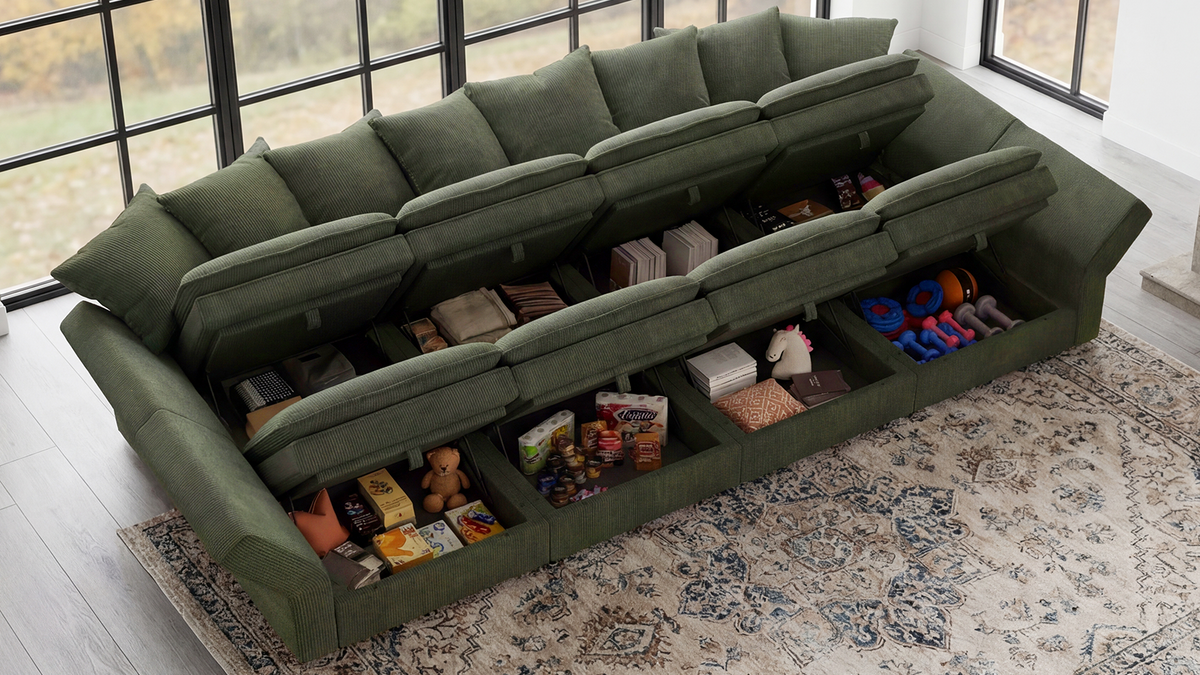
A fixed storage chaise usually holds the most, since it runs the depth of an entire lounge section instead of one seat cushion. A storage ottoman holds less but stays easiest to reach, since it moves wherever it's needed. A storage seat holds the least, yet its light lid makes it the one most households actually open every day.
Capacity Isn't the Only Difference
A fixed chaise wins on raw volume, an ottoman sits in the middle, and a single seat holds the least of the three. That ranking rarely changes, but it only tells part of the story.
| Storage type | Relative capacity | How it sits in the layout |
|---|---|---|
| Storage chaise | Highest, spans the full lounge section | Fixed in place once the sectional is set up |
| Storage ottoman | Moderate, roughly half of a chaise | Its own module, can be repositioned |
| Storage seat | Lowest, sized to one cushion | Fixed within the seating row |

The chaise’s advantage comes from depth as much as length, so it suits bulkier items that would crowd a smaller compartment. A household storing spare bedding or seasonal throws gets more practical use from that extra depth than from an ottoman’s smaller, easier-to-reach space. Everyday items, the ones grabbed several times a week, tend to fit an ottoman or a seat just as well, so the largest storage module isn’t automatically the right one for a given household.
Opening Direction and Cushion Removal
Each storage type opens differently, and that difference decides how much effort it takes to grab something inside. A storage chaise can go either way: some lift off in one piece, others hinge along the back edge like an oversized ottoman lid. A storage seat's cushion usually lifts off completely, with no hinge holding it in place. A storage ottoman's lid is hinged at the back, so the cushioned top swings open and stays attached.
Pick a hinged lid if the compartment gets opened several times a day, since there's nowhere to set a loose cushion down each time. A hinge does need clearance above it to swing fully open, so check that a nearby wall, shelf, or side table doesn't block the arc before settling on a placement.
A lift-off cushion suits storage that gets opened less often, since it has one fewer moving part to wear out. The tradeoff is weight. A full chaise-sized cushion can be heavy enough that lifting it alone isn't comfortable for everyone in the household.
Access After You Rearrange the Sofa
A storage ottoman keeps working the same way no matter how the rest of the sectional gets rearranged, since it's a separate piece rather than something built into a fixed corner. Move the sectional against a different wall, swap the chaise to the other side, or split the pieces into two smaller groupings, and the ottoman still opens exactly as before.

Storage built into a chaise or a seat behaves differently, because it travels with that specific section. A fixed U-shaped layout keeps the chaise's storage in one corner permanently, while a chaise designed to attach on either end can move, but only if the sectional's connectors are the reversible kind. Check that detail before assuming a storage chaise can switch sides later.
A storage seat generally moves wherever the seating row goes, since it connects the same way as the sectional's other seats. This flexibility makes it the easiest of the three to plan around during a room rearrange, even though it holds the least, an important consideration when comparing different sectional sofa layouts.
Blankets, Toys, and Everyday Items That Actually Fit

What actually fits depends on both size and how deep the compartment runs, not just its listed volume.
- Storage chaise: spare bedding, out-of-season throws, guest pillows, larger board games
- Storage ottoman: everyday blankets, remote caddies, magazines, a child's small toy bin
- Storage seat: a single throw, flat games, chargers and remotes, seasonal decor in small batches
A deep chaise compartment handles a folded comforter without much trouble, while an ottoman or a seat usually needs bulkier items folded tighter or split across two spots. Toy storage favors the ottoman specifically, since its front-and-center position and hinged lid make it the type kids can open and close on their own most easily.
The Module Most Likely to Stay Usable Long-Term
Fewer moving parts tend to mean fewer problems years down the road. A lift-off cushion, with no hinge at all, has less hardware that can loosen or squeak over time compared with a hinged lid that opens and closes daily.
Hinges on an ottoman or a chaise generally hold up fine under normal use, but a household that opens the same lid multiple times a day will feel wear sooner than one that opens it a few times a month. If daily access matters, a hinge that stays snug after frequent use matters more than one that simply looks sturdy in a showroom.
A storage seat's simplicity works in its favor here. With just a cushion and a shallow compartment, there's little that can go wrong mechanically, even if it never holds as much as the other two.
Choose Storage Based on How Often You'll Open It
A chaise makes sense for bulky, occasional-use items and a household that values total volume over easy access. An ottoman fits daily routines and rooms that get rearranged often. A seat suits smaller households or anyone who wants the simplest mechanism to maintain. Match the choice to how often the compartment will actually get opened, not to which storage module sounds biggest on a spec sheet.
Common Questions About Storage Chaises, Ottomans, and Seats。
Q1: Can a storage ottoman be used as extra seating when guests are over?
Most are built sturdy enough for occasional sitting, though they're not designed for the same daily weight as a regular seat cushion. Check the weight rating before relying on it as a permanent extra seat.
Q2: Does a storage seat's cushion need to be replaced separately from the sectional's other cushions?
Usually not. Most manufacturers use the same cushion covers and foam across every seat in a configuration, including the ones with storage underneath, so replacement parts match the rest of the piece.
Q3: Can items stored inside a chaise get musty if the lid stays closed for months?
It's possible in a humid climate, since a sealed compartment doesn't get the airflow that open shelving does. Storing a small moisture absorber packet inside, or airing the compartment out every few months, helps prevent that.
Q4: Is a hinged ottoman lid safe for a home with young children?
Look for a lid with a soft-close or stay-open hinge, since an unsupported lid that drops on its own poses a pinch risk for small fingers. Most modern designs include one or the other.
Q5: Do storage seats and ottomans use the same size compartment across a whole sectional line?
Not necessarily. Compartment size can vary between configurations even within the same collection, so it's worth checking the specific measurements for the piece being considered rather than assuming they match.

Leave a comment
This site is protected by hCaptcha and the hCaptcha Privacy Policy and Terms of Service apply.