

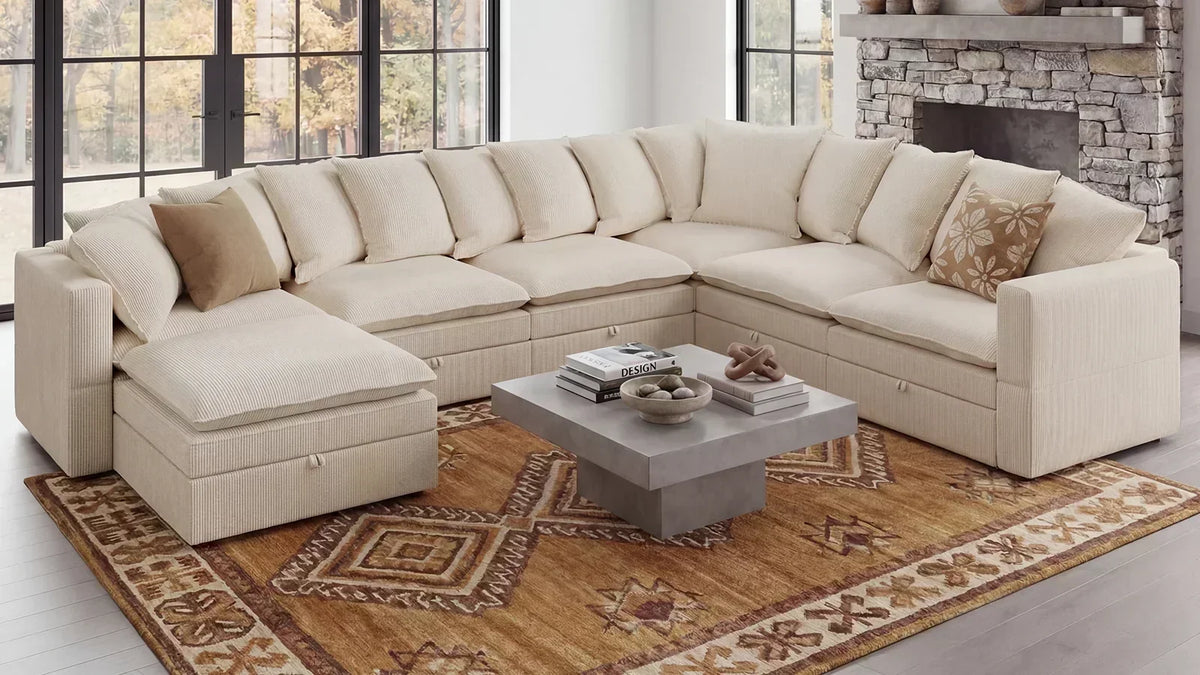
A sleeper sectional is a sectional sofa with a bed built into one of its modules, most often a folding frame and mattress pad hidden under the seat cushions. What separates it from a regular sectional is that mechanism: a regular sectional is seating only, while a sleeper sectional folds, pulls, or reconfigures into a usable sleeping surface without adding a separate piece of furniture to the room.
More Than a Sectional With an Extra Step
A sleeper sectional earns its name because the sleep function is engineered into the seating, not added on as an afterthought. One module, usually a central seat run or a chaise, hides a folding metal frame and a mattress pad underneath cushions that look identical to the rest of the sofa when it's closed.
That's the real dividing line from a regular sectional. A regular sectional's seat cushions sit on decking or webbing built only to hold a sitting weight, while a sleeper sectional's sleep module sits on a frame built to fold flat and support a lying-down weight too. Everything else, the fabric, the arm style, the number of pieces, can look identical between the two.
What Happens the Moment the Bed Opens
The bed changes the room in three ways the moment it opens: the seat cushions come off, a metal frame unfolds from underneath, and the sofa's footprint grows by several feet in one direction. That sequence is the plain answer to how a sleeper sectional actually works once you get past the listing photos.
Most mechanisms need the cushions removed and set aside before the frame will unfold, since the folded frame sits directly beneath them. Once unfolded, the frame locks flat and the mattress pad becomes the sleeping surface. The whole process usually takes under a minute once it's familiar, though a chaise-style sleeper can add a step since the chaise base sometimes needs to be cleared first.

Pull-Out, Fold-Flat, and Modular Mechanisms
Three different mechanisms get sold under the sleeper sectional label, and they don't open the same way or use the same amount of floor space.
| Mechanism | How it opens | Floor space it needs |
|---|---|---|
| Pull-out | A folding frame slides forward and unfolds from inside the seat base | Most, since the bed extends past the sofa's front edge |
| Fold-flat | The seat back drops down flush with the seat to form one flat surface | Least, since it uses the sofa's existing footprint |
| Modular | Separate seat or ottoman pieces push together into a sleeping platform | Varies, since the modules can be rearranged around the room |
A pull-out mechanism is the most common choice on modular sleeper sectionals since it fits inside a single module without changing the sofa's shape when closed. Fold-flat designs trade some sleep comfort for a simpler, sturdier mechanism, and modular platforms give up a dedicated mattress pad for a sleeping surface that can be reshaped along with the rest of the sofa. This is also where a sectional couch that turns into a bed differs most from a standalone sofa bed: a sectional's separate modules give it layout options a single fixed frame doesn't have.
Storage Hiding Inside Seats, Chaises, and Ottomans
Storage shows up in the same three spots on most sleeper sectionals: a lift-up seat cushion, a chaise base, or a separate storage ottoman, and where it lands usually depends on which sleep mechanism the sofa uses.
A pull-out sleeper sectional typically leaves the seat cushion itself as the storage access point, since the folding frame occupies the rest of the module. A chaise-based sleeper often keeps its storage in a second, non-sleeping chaise so the compartment isn't blocked by the folded frame underneath. Modular sleepers can tuck storage into whichever ottoman isn't part of the sleeping platform on a given night, which is one advantage a modular sofa bed setup has over a single fixed sleeper module.

Who This Sofa Actually Makes Sense For
A sleeper sectional makes the most sense for anyone who wants a real guest bed without buying a separate piece of furniture. It's a weaker fit for anyone planning to sleep on it every night, since even a well-built mechanism trades some comfort for the ability to fold flat and disappear during the day.
Occasional hosts, small apartments without room for a dedicated guest room, and households that would rather use the space for daily seating and reserve the bed for a handful of nights a year get the most value from the format. Anyone furnishing a room around nightly sleeping is usually better served by a dedicated bed frame, even if that means finding space for one more piece of furniture.

Decide Based on the Mechanism, Not Just the Look
The label "sleeper sectional" covers pull-out, fold-flat, and modular designs that open differently, need different amounts of floor space, and hide storage in different spots, so the mechanism underneath matters more than how the sofa looks closed. Match the mechanism, the storage location, and how often the bed will actually get used before comparing fabric or layout any further.
Sleeper Sectional FAQs
Q1: What is the difference between a sleeper sofa and a sleeper sectional?
A sleeper sofa is a single fixed piece with the sleep mechanism built into its one seat run, while a sleeper sectional is made of separate connected modules, only one of which usually contains the mechanism.
That modularity means a sleeper sectional can offer more seating and be rearranged later, at the cost of taking up more total floor space than a single sleeper sofa.
Q2: Do sleeper sectionals have a separate mattress?
Most use a thin mattress pad built into the folding frame rather than a separate mattress bought on its own, and that pad tends to be thinner and firmer than a standard bed mattress.
A foam topper is a common addition for anyone using the sleeper function more than occasionally.
Q3: How long does it actually take to set up a sleeper sectional for the night?
Under a minute for most pull-out or fold-flat mechanisms once the cushions are cleared, and closer to two or three minutes the first few times before the motion becomes familiar.
Chaise-style sleepers can take slightly longer if the chaise base needs to be cleared first.
Q4: Does a sleeper sectional cost more than a regular sectional of the same size?
Generally yes, since the folding frame and mattress pad add both material and manufacturing cost that a seating-only sectional doesn't carry.
The exact gap varies by brand and configuration, but a sleeper version of a comparable sectional typically costs somewhat more than the non-sleeper equivalent.
Q5: Can a sleeper sectional's mechanism be repaired if it stops folding smoothly?
Usually, since most mechanisms are bolted-in metal frames rather than something welded permanently to the sofa.
A sticking or squeaking mechanism is often fixed by tightening loose bolts or lubricating the hinges, though a bent frame or broken spring may need a replacement part from the manufacturer.

Leave a comment
This site is protected by hCaptcha and the hCaptcha Privacy Policy and Terms of Service apply.