

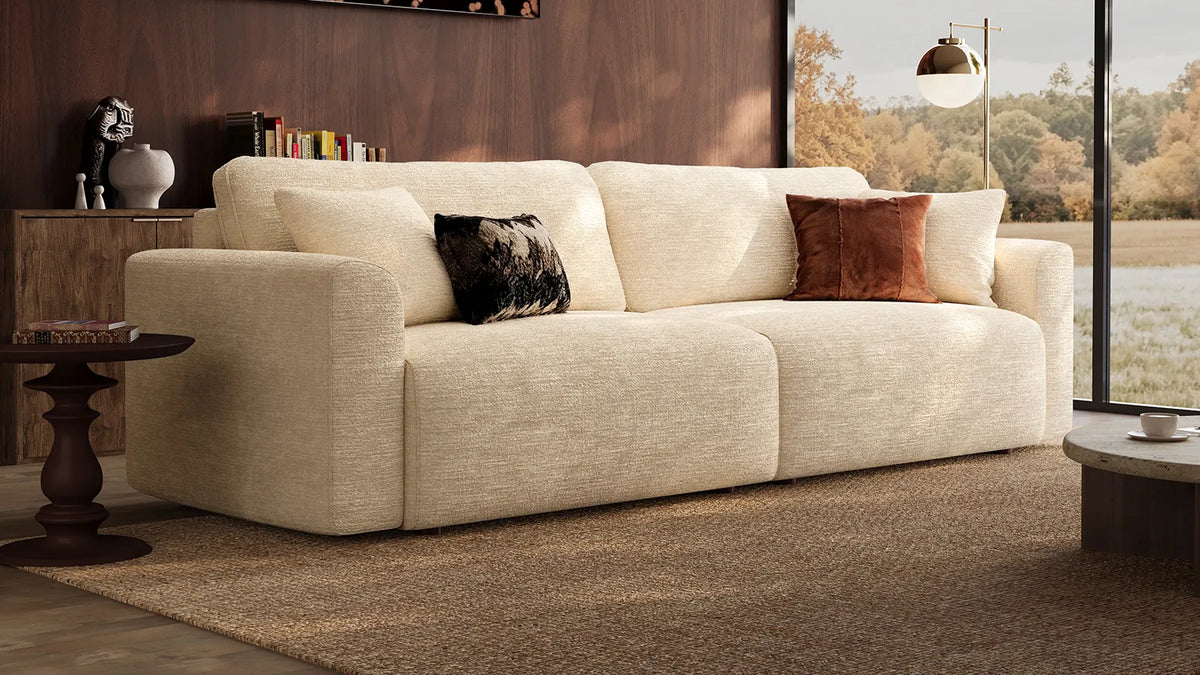
A loveseat fits a small living room when its full footprint leaves a clear route through the room, space for the furniture you already use, and room to sit down comfortably. Start with the usable wall and room depth, rather than the product photo. A compact modular sofa for small living room layouts can work especially well when each piece earns its floor space.
The Room, Not the Listing Photo, Sets the Size Limit
The best loveseat for a small living room is the one that fits the room’s usable rectangle, not simply the longest empty wall. A photo can make a two-seat sofa look slim because it leaves out door swings, radiators, windows, and the route people take between rooms.
Measure the Usable Wall
Measure the clear wall from one fixed obstacle to the next. Stop at a heater, a doorway, a low window ledge, or anything that prevents the loveseat from sitting where you planned. That number, not the wall-to-wall dimension, is the maximum width available for the back of the piece.
Measure room depth from that wall to the first fixed object. It has to hold the loveseat and the activity in front of it.
Mark What Cannot Move
Small rooms lose usable space in uneven ways. Make a simple sketch and include the following before comparing dimensions:
- Door swings and closet doors
- Baseboard heaters, radiators, and floor vents
- Windows, curtains, and low sills
- Built-ins, outlets, and wall registers
- The route from the entry to the next most-used room
The sketch prevents a common mistake: picking a loveseat that fits the wall but blocks the only route into the room.

Width, Seat Depth, and Arm Thickness Change the Fit
Two loveseats with the same overall width can feel very different in a small room. Overall width sets the wall requirement, seat depth sets how far the piece reaches into the room, and arm thickness decides how much of that footprint becomes usable sitting space.
Use the dimensions on a listing as a three-part check, rather than looking at the width alone.
| Dimension | What It Changes | What to Check at Home |
|---|---|---|
| Overall width | How much wall the loveseat uses | Clear wall width between obstacles |
| Overall depth | How far it projects into the room | Distance to the coffee table or opposite furniture |
| Seat depth | How relaxed or upright the seat feels | Whether your knees and coffee table still have room |
| Arm thickness | Usable cushion width | Whether two adults can sit comfortably |
| Back height | Window and sightline clearance | Whether it blocks a sill or makes a low room feel closed in |
A Wider Seat Is Not Always a Wider Loveseat
Look for the inside seat width when two people will use the loveseat regularly. Thick, padded arms can take several inches from the cushion area while keeping the same outside measurement. A cleaner arm shape may provide similar seating without taking more of the room.
The better fit gives two people enough cushion width while leaving room for a side table and light switches.
Total Depth Matters More Than a Deep-Looking Cushion
Check total depth before deciding that a deep seat is right for a narrow room. Seat depth measures the space from the front edge of the cushion to the back cushion, while total depth includes the back, frame, and front edge. The total number is what reaches into the walkway.
Mark the coffee table farther forward on your tape plan before ordering a deep seat. It is a poor trade if everyone has to turn sideways to pass.

Keep a Walkway Before You Choose a Wider Seat
Protect the main walking route first, then spend the remaining room on seating. In a compact living room, an extra few inches of loveseat width rarely helps if it turns the path from the entry to the kitchen, hallway, or balcony into an obstacle course.
We suggest leaving at least 36 inches for a walkway and 18 inches between a sofa and coffee table. Treat those as a practical starting point, then test them against your own doors, mobility needs, and furniture. A secondary path can sometimes be tighter, but the route used every day should feel easy when someone is already seated.
Plan the Coffee Table Zone
Set the coffee table position before finalizing loveseat depth. Mark the table’s actual footprint and include the distance needed to reach a drink, stand up, and pass in front of the seat. A table that looks proportionate in a staged room may take away the knee space that makes a compact layout comfortable.
Choose a lighter table if the room serves several purposes. It can move for visitors or a temporary work surface without shifting the loveseat.
Leave the Door Arc Alone
Open every nearby door fully while the floor plan is marked. A front door, closet door, or cabinet that clips the loveseat corner will become an everyday frustration. Moving the loveseat a few inches off-center can solve the issue, but only if it does not steal the walkway on the other side.
Enough clearance for an empty room is not enough if a seated person or an open door makes the route unusable.

Doorways, Stairs, and Box Size Can Rule Out a Loveseat
Delivery access can eliminate a loveseat that fits the room perfectly. Measure the complete route from the building entrance to the living room before comparing the furniture’s packaged dimensions or individual module dimensions.
Follow the Delivery Path in Order
Write down the narrowest measurement at each point. Door frames, handles, elevator doors, and tight stair turns matter more than the widest stretch of a hall.
- Building entry and apartment doorway width
- Hallway width at corners
- Elevator door opening, cabin width, and cabin depth
- Stair landing width, depth, and ceiling clearance
- The final turn into the living room
Modular pieces can make a tight route easier because they travel separately, but a smaller piece is not automatically easy to deliver. The carton has its own width, height, and turning needs. Our shipping and delivery details also confirm that service is limited to eligible U.S. addresses, so building access is worth resolving before delivery day.
Compare the Box, Not Only the Assembled Loveseat
Ask for package dimensions when they are available, particularly for an apartment with an elevator or a turn at the top of a staircase. A boxed arm or seat may need more diagonal room than its finished position suggests.
Keep the measurements and route photos with your order notes instead of estimating a narrow landing from memory.
Decide Whether It Is Primary Seating or a Second Seat
The right size changes with the loveseat’s job. A primary seat needs enough usable cushion space and support for the people who sit there most nights. A second seat can be narrower or more flexible because it fills a specific corner, reading area, or conversation zone.
When the Loveseat Is the Main Sofa
Prioritize two-person comfort and the activities that happen in front of the seat. Measure for the coffee table, television viewing distance, side-table access, and the place where a blanket or bag usually lands. A little extra seating width can be worthwhile when this is the only place two people relax together.
Avoid a main seat that technically holds two people but leaves both on the front edge. A straight arrangement with slimmer arms may use the room more effectively.
When the Loveseat Supplements Other Seating
Use the smallest footprint that solves the real need. A second seat may only need to support conversation, a reading corner, or an occasional guest. It does not need to duplicate the function of the main sofa.
A movable ottoman can become an extra perch when company arrives, then return to a footrest without extending the traffic lane.

A Tape Outline Shows Problems Before Delivery Day
A full-size tape outline is the quickest way to answer what size loveseat for a small room. Mark the outside width and total depth, then add the coffee table, door arcs, and the route people use most often. Keep the outline down for a day or two rather than judging it in one quick look.
Test Daily Movements
Walk in with groceries, open the closet, sit down, and pass the coffee table while another person occupies the planned seat. These ordinary movements expose problems that a dimension list cannot show. If the tape feels restrictive, the finished furniture will feel more restrictive.
Test the Flexible Layout Too
For a modular sofa for small living room use, mark its alternate arrangement too. The layout is flexible only when every moved piece has a place that does not block the room.
Reduce width, choose slimmer arms, or move to a straighter arrangement if the outline closes the main path. Empty floor is not wasted space in a small living room. It is what makes the seating usable every day.
Measure the Room Before You Compare Loveseats
Start with the usable wall, total room depth, protected walkway, and full delivery route. Then choose the loveseat whose outside dimensions and usable seat width match its role in your home. A small loveseat earns its place when two people can sit comfortably and everyone can still move through the room. Bring those measurements when you compare our modular seating options.
Common Questions About Loveseat Size and Small Living Rooms
Q1: How wide is a standard loveseat?
Most loveseats are designed for two people, but there is no single standard width. Compare overall width with inside seat width because thick arms can make a wide frame offer less room than expected.
Q2: Can a loveseat fit in a 10 by 10 living room?
Yes, if its depth leaves a usable route and room for the furniture opposite it. Door locations and the coffee table decide the outcome.
Q3: Should a loveseat touch the wall in a small room?
Usually, yes. It preserves open floor, provided it does not cover a vent, interfere with curtains, or block a needed outlet.
Q4: Is a loveseat too small for two adults?
No, if the inside cushion width and seat depth suit how they sit. Check those measurements instead of relying on outside width.
Q5: What furniture should go with a loveseat in a small living room?
Choose pieces that preserve open floor, such as nesting tables or a compact ottoman. Heavy furniture on both sides can make the room feel crowded even when the loveseat fits.

Leave a comment
This site is protected by hCaptcha and the hCaptcha Privacy Policy and Terms of Service apply.